


Beat the Burnout: Supporting Your Nervous System Before Fall Arrives

Updated: Aug 5
By the time August rolls around, most of us are running on fumes and calling it normal. The summer travel, the late nights, the heat, the packed schedules before school starts back up. We tend to treat exhaustion as something to push through rather than something the body is actively trying to tell us about. But burnout is not a personality flaw or a scheduling problem. It is a physiological state, and understanding what is actually happening underneath it is the first step toward recovering from it.
Burnout Is Not Just in Your Head
When people describe burnout, they usually talk about it in emotional terms. Feeling foggy, irritable, unmotivated, stretched too thin. Those experiences are real, but they are also symptoms of something happening at a biological level. Chronic stress puts ongoing demand on the hypothalamic pituitary adrenal axis, often shortened to the HPA axis, which is the communication system between your brain and your adrenal glands. This system is responsible for regulating cortisol, the hormone that helps you wake up in the morning, respond to stress, and eventually wind down at night.
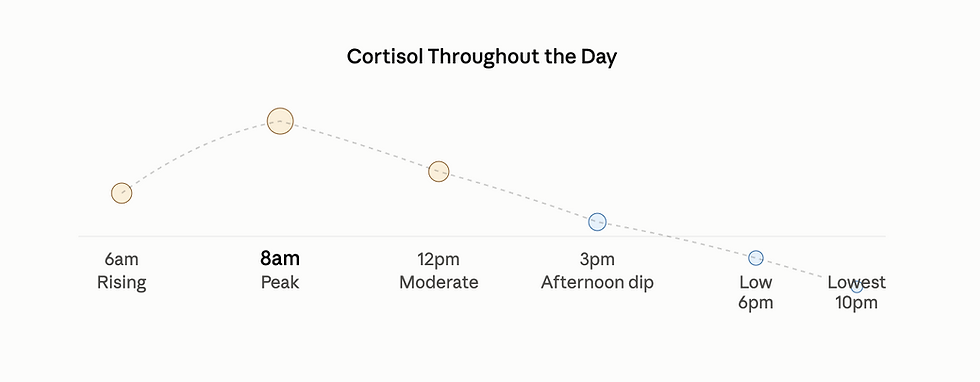
Under normal circumstances, cortisol follows a rhythm. It rises in the early morning to
help you feel alert, then gradually declines throughout the day so your body can relax into rest by evening. When stress becomes chronic rather than occasional, that rhythm gets disrupted. Some people end up with cortisol that stays elevated too long into the evening, leaving them wired but exhausted at bedtime. Others find their cortisol has flattened out entirely, leaving them running on empty with little reserve left to draw from. This is often what people are describing when they say they feel tired but wired, or exhausted no matter how much they sleep.
This is also why burnout so often gets missed in a standard checkup. Bloodwork can look normal while someone is still struggling, because conventional testing is not always designed to catch these more subtle patterns of dysregulation. It does not mean nothing is wrong. It often means the picture is more nuanced than a single lab value can capture, and it usually calls for a closer, more individualized look.
Signs Your Nervous System Is Asking for a Break
Burnout does not always look like collapsing on the couch unable to move. More often, it shows up in quieter ways that are easy to dismiss or explain away. A few common signs worth paying attention to include feeling tired all day but suddenly wide awake at night, relying on caffeine or sugar just to get through the afternoon, noticing your patience has grown shorter than usual, waking up unrefreshed even after a full night of sleep, and losing motivation for things that used to feel manageable or even enjoyable.

None of these signs on their own are cause for alarm. But when several of them show up together and start to feel like your new normal, it is worth taking seriously. The body is not malfunctioning. It is adapting to prolonged demand, and it is asking for support.
Subtraction Before Addition
One of the most important shifts in recovering from burnout is recognizing that healing is often less about adding more to your plate and more about taking things off of it. It is tempting to search for the perfect supplement or the ideal morning routine, but if the underlying stress load never changes, no amount of adding on top of it will fully resolve the exhaustion.
Before reaching for anything new, it can help to ask what could be removed or simplified. That might mean cutting back on caffeine that is propping up energy but disrupting sleep, saying no to one more commitment that does not feel essential, or simply giving yourself permission to rest without guilt. Subtraction is rarely glamorous, but it tends to be the foundation that everything else builds on.
Small, Sustainable Supports
Once that foundation is in place, there are gentle practices that can help support a healthier stress response. Getting natural light exposure within the first hour of waking helps reinforce a healthy cortisol rhythm. Delaying caffeine by even thirty to sixty minutes after waking allows your body's own cortisol to do its job first, rather than immediately relying on stimulation. In the evening, creating a wind down routine, even a simple one, signals to your nervous system that it is safe to relax.

Simple dietary shifts can help too. A smoothie built around ingredients like turmeric, maca, and healthy fats can offer steady, grounding energy in the morning without the crash that often follows sugar or excess caffeine. A calming, caffeine free tea in the afternoon can be a small but meaningful swap for people looking to reduce their reliance on stimulants throughout the day.

You Do Not Have to Figure This Out Alone
If you have been told your labs look normal but you still do not feel like yourself, please know that your experience is valid, and there is often more going on beneath the surface than a standard panel can capture. Functional lab analysis takes a closer look at patterns that conventional testing may overlook, and can offer real clarity on what your body actually needs.
Recovering from burnout is rarely about a single fix. It is a gradual process of listening to what your body has been trying to tell you, removing what no longer serves you, and rebuilding in a way that is sustainable rather than another thing to keep up with.
This is exactly the kind of work Dr. Kizzy Raphael and Dr. Amanda Wilms love supporting patients through. Dr. Kizzy specializes in adrenal fatigue, thyroid disorders, digestive issues, and bioidentical hormones, and can help you get to the root of why you have been feeling so depleted. Dr. Amanda brings her expertise in complex chronic illness, including mycotoxin illness and environmental medicine, for those whose exhaustion may be tied to something deeper. Together, they take the time to understand your unique story rather than treating your symptoms as a checklist.
If you are ready for support along the way, we would be glad to help you find your way back to feeling like yourself again. Reach out to schedule your free 15 minute consultation and let's talk about what your body has been trying to tell you.


Comments